What was actually bought
On 15 September 2026 Strohm announced a contract from Petrobras to supply thermoplastic composite pipe — TCP — for Brazil's deepwater post-salt province. The scope includes qualification testing, engineering, field services and support for offshore trials and installation. The applications named are water injection and gas lift, at water depths up to 1,500 m. The pipe is carbon or glass fibre in a polymer matrix, spoolable, and to be trialled for handling and installation from pipe-lay vessels Petrobras already runs.
Read the applications again, because they are the story. Not production. Not gas injection. Not pre-salt.
To see why that matters, you have to know what is wrong with the steel.
The failure mode, from the regulator
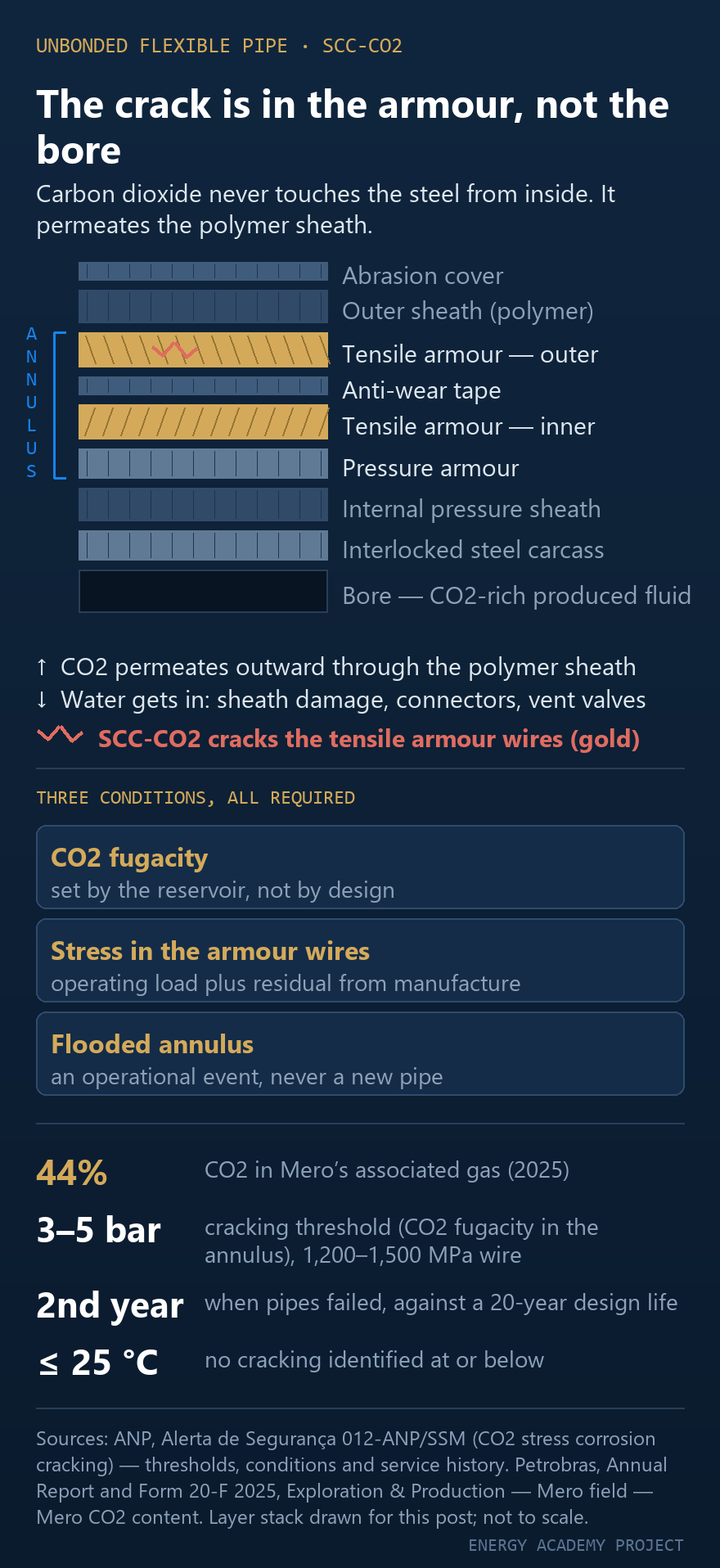
Brazil's ANP issued a safety alert — Alerta de Segurança 012-ANP/SSM — on carbon dioxide stress corrosion cracking, SCC-CO₂.
The alert states that incidents began in 2016, in gas injection and production flexible pipes carrying high CO₂ content, and that failures appeared from the second year of operation against a manufacturer's stated design life of 20 years. That is the sentence to sit with: a twenty-year pipe failing in year two.
Three conditions must coincide, all of them:
- CO₂ fugacity — a property of the reservoir, not of the design;
- stress or strain in the pipe — the alert is explicit that both operating load and residual stress from manufacture were sufficient to activate the mechanism;
- a flooded annulus — water in the space between the internal pressure sheath and the outer sheath.
The geometry surprises people who have not worked on flexibles. The steel that cracks never touches the produced fluid. CO₂ permeates outward through the internal polymer sheath into the annulus. If that annulus is dry, the mechanism does not initiate; the annulus is normally gas-filled and vented. Flooding is an operational event — a damaged outer sheath, a connector, a vent valve. A new pipe does not have a flooded annulus. It acquires one.
The numbers in the alert that nobody quotes
The alert does not stop at the mechanism. It carries a working envelope, from the operator's own design measures, reported under lessons learned:
- For high-strength wire — 1,200 to 1,500 MPa UTS — there may be a cracking threshold between 3 and 5 bar of CO₂ fugacity in the annulus. Lower-strength steels are less susceptible. Strength is a liability here.
- No cracking was identified at temperatures of 25 °C or below.
- Susceptibility was not found in oil production lines to the degree seen in gas injection lines.
- Top sections live longer. In the flooded condition, the alert reports significantly longer SCC-CO₂ life in the upper riser sections, because CO₂ pressure in the annulus there is lower — surface venting continuously removes gas from the annulus.
The damage is not uniform along the line, and the reason is a boundary condition at the top.
Why Brazil, and the one CO₂ number that is primary
The reservoir supplies the first condition, and in the Santos Basin it supplies it generously. Petrobras' Form 20-F for 2025 describes Mero in its own words, in the Exploration & Production — Mero field section: "The project faces notable challenges, considering the high gas/oil ratio (415 std m³/std m³) and CO2 content in the associated gas (44%)."
44%. That is Petrobras' own figure in a document filed with the SEC — a place where being wrong has consequences — and it is worth stating plainly, because the range that circulates in commentary — 38 to 42% — is lower and unsourced.
One caution: this is Mero's number, not the pre-salt's. There is no such thing as "the CO₂ content of the pre-salt". It varies by accumulation, across orders of magnitude, within the same play. Búzios has no official CO₂ figure at all — the values quoted come from trade press and from a paper reporting a single well.
What the operator says it costs
SCC-CO₂ is not a background worry at Petrobras. It is a reported performance indicator. The 20-F glossary defines "SCC-CO2 production losses" as the measure of "the absolute production loss resulting from stress corrosion cracking, induced by CO2 in production pipelines." The company reports that in 2025 those subsea SCC-CO₂-related production losses were 34% lower than forecast after inspection campaigns and engineering actions, and that it has contracted and executed three Technological Development Orders (ETECs) aimed at creating flexible pipes immune to SCC-CO₂.
Two supplier programmes are public. NOV announced a pre-commercial agreement in March 2025 covering stainless steel armouring, for 6 in and 8 in production and gas injection risers and flowlines. Baker Hughes announced one the same month, targeting 30 years of service life in a high-CO₂ environment.
When mitigation fails, the bill arrives at the end of life. A 2026 Petrobras paper documents the decommissioning of the SPA-1 system at Mero — lines that served the FPSO Pioneiro de Libra between 2017 and 2022, 21 km of flexible pipe. Retrieval began in 2023 and was suspended. One section failed during a proof load test in November 2023, which proved the test worked. A later section failed after passing it, at the connector, on the work table of a pipe-lay vessel, with people nearby on routine accessory removal. The paper reports no injuries. The revised method splits the job in two: where the exposure can be designed out, accessories come off subsea by ROV and the proof load carries a 1.25 factor; where it cannot, the retrieval load is capped so the line must come in over the PLSV stern, under a stricter test. The pilot ran four vessels simultaneously to recover one interconnection.
Embrittled pipe is expensive to own and expensive to let go of.
So what did the award actually signal?
TCP has no tensile armour wires. Remove the steel and you remove the thing that cracks — the SCC-CO₂ locus does not exist in a carbon-fibre laminate.
But Strohm's release does not mention CO₂ at all, and the duties bought are water injection and gas lift in the post-salt. That is not a hedge on the technology; it is how qualification is supposed to work. You do not debut a new pressure-containing material on the highest-consequence, highest-CO₂, highest-GOR duty in the country. You put it in a benign service at a depth you have already trialled, and you collect evidence.
Meanwhile the steel is not being abandoned. In the same fortnight, trade press reported bids in a large Petrobras tender for up to 518.3 km of flexible lines, in two lots, with SCC-CO₂-resistant pipe explicitly in scope. Reported bid values put Baker Hughes lowest, at about R$ 3.1 bn and R$ 3.2 bn for the two lots. The tender scope and the bid values are both a single trade-press report; no primary source, no award announced. Treat them as an order of magnitude and nothing more. The direction is not in doubt: Brazil is buying a great deal of flexible pipe, and specifying it against a failure mode it had not seen before 2016.
What to watch
Three signals, none of which has happened yet:
- TCP moving up in duty — to production or gas injection service, or into the pre-salt. That is the qualification step that would matter.
- An ETEC pipe qualified and ordered. "Immune to SCC-CO₂" is a design target in an annual report. The test is a purchase order against a real riser specification.
- The alert being revised. The envelope in ANP's alert — the 3 to 5 bar threshold, the 25 °C observation — came out of dissections and lab work on a young failure mode. It should move as the dataset grows, and when it moves, so do a lot of life-extension calculations.