What started
On 18 September 2026 the Greensand project began commercial CO₂ storage in the Danish sector of the North Sea. The operator's figure for this first commercial phase is up to 400,000 tonnes of CO₂ per year, injected into the Nini West reservoir — a depleted oil field described as approximately 1,800 metres beneath the seabed.
There is no pipeline. CO₂ is captured onshore, liquefied, trucked to a terminal at Port Esbjerg, loaded onto a single purpose-built carrier and sailed out to a platform. That is the whole chain, and it is the reason this project is worth an engineer's attention. The reservoir is ordinary. The delivery is not. The CO₂ itself is biogenic — the European Commission's opinion on the draft permit records it as coming from biogenic sources, with a CO₂ content above 95 % and no water, and therefore no expected SOx or NOx.
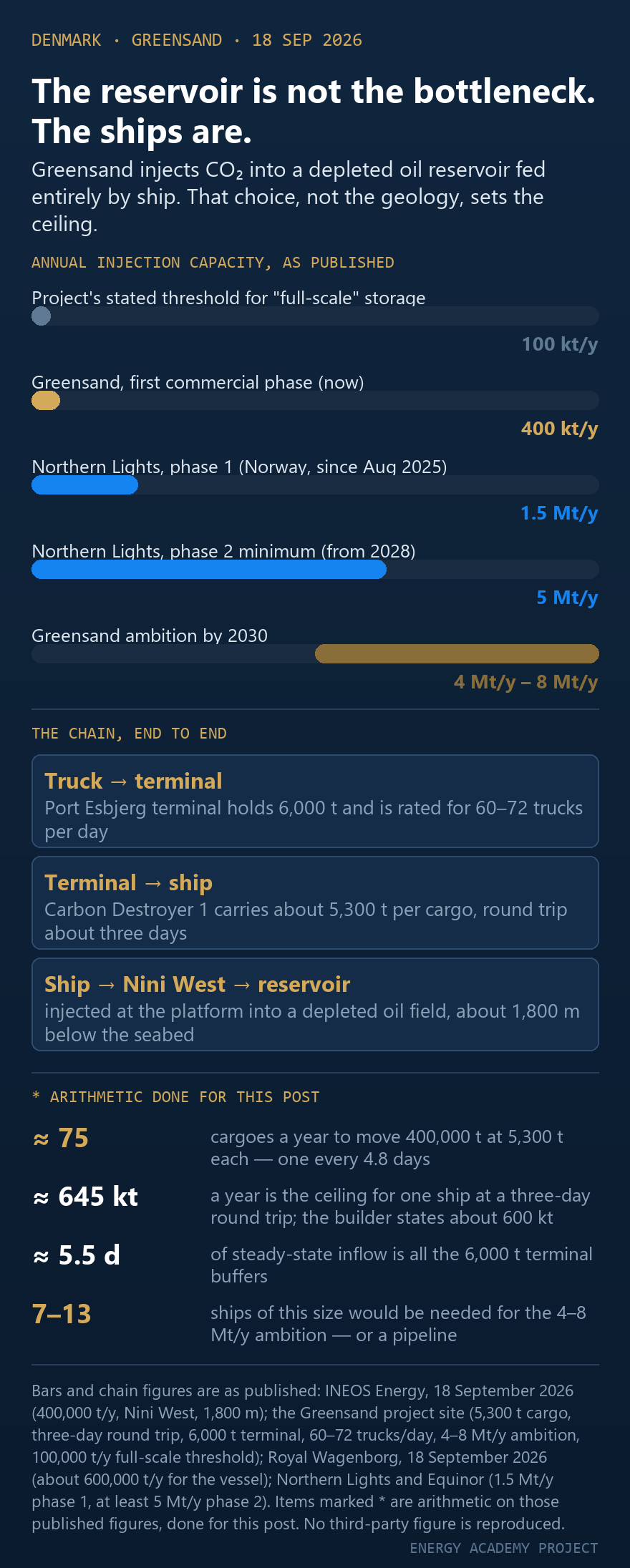
The chain, as published
Four numbers define it, all from the project or the shipbuilder:
- the terminal at Port Esbjerg holds 6,000 t and is rated for 60 to 72 trucks per day;
- Carbon Destroyer 1 carries about 5,300 t per cargo;
- the round trip from Esbjerg to the field and back takes about three days;
- the builder puts the vessel's annual transport capacity at about 600,000 t.
The arithmetic nobody publishes
The following is our arithmetic on those published figures, not a claim by anyone involved.
Four hundred thousand tonnes a year at 5,300 t a cargo is about 75 cargoes, one every 4.8 days. A three-day round trip means one ship can in principle make roughly 122 trips a year, or about 645,000 t — which lands close enough to the builder's stated 600,000 t to say the two figures describe the same vessel doing the same job. So the first phase runs this ship at roughly two-thirds of its own annual capability. The slack in the system is in the ship, not in the store.
Now the buffer. Steady-state inflow at 400,000 t/y is about 1,096 t/day. The terminal holds 6,000 t — about 5.5 days of that inflow, or a little over one shipload. Put the same numbers the other way: 1,096 t/day arriving in 60 to 72 trucks would mean 15 to 18 t a load, which is under what a CO₂ road tanker carries — so the terminal's truck rating is not the binding constraint in this phase. It has headroom. The ship does not.
That 5.5-day figure is the one to sit with. A North Sea weather window that keeps a DP2 vessel off station for a week fills the terminal. When the terminal is full, the trucks stop; when the trucks stop, the capture plants upstream have nowhere to send product. In a pipeline-fed system the storage site absorbs that. Here the buffer is one tank farm and one hull.
What the well sees
The project states that the injectors are existing wells, originally drilled as oil producers, reconfigured by running wire about 1,800 m down to install new equipment and barriers — work done from the platform, with crew arriving by helicopter or by walk-to-work gangway. It does not say how many wells.
Two things follow, and both are our reading rather than anyone's statement.
First, re-used producers carry their history. The reservoir here is the Frigg Member — twelve to thirty metres of porous, glauconitic sandstone on the western flank of the Nini salt structure at about 1,700 to 1,800 m TVDSS, sealed below by the Balder Formation, as the Danish regulator's own permit describes it. A well completed for oil in that sand was not specified for decades of wet CO₂ against carbon steel. Legacy casing and legacy cement become the barrier envelope for a new fluid, and the wireline-set equipment is the visible part of a qualification argument that is mostly about what was already downhole. Worth noting that the permit counts three legacy wells in the storage complex — the Nini-4 exploration well, the former oil producer NA-03 and the field's water injection well NA-05 — for five reservoir penetrations in total, and that the 2022 pilot injected through NA-05. "Existing oil producer" is the project's description of the commercial injectors, not of every well in the complex.
Second, and more particular to this project: ship-fed injection is batch injection unless something smooths it. Seventy-five cargoes a year is seventy-five arrivals. Whether that translates into seventy-five start-stop cycles at the wellhead depends on whether there is buffer storage on the platform between cargoes — and that is precisely what none of the published material says. It matters because a depleted reservoir sits at low pressure, and liquid CO₂ crossing a large pressure drop cools sharply. Cyclic pressure and temperature at the completion, rather than the reservoir itself, is where a ship-fed injector differs from a pipeline-fed one.
The 2022 pilot is the one place where the cycle is on the record. Its permit allowed up to fourteen round trips with cargoes of up to 880 t, pumped from ISO tanks through a flexible hose, and CO₂ injected cyclically at about 40 m³/h — each injection lasting roughly twenty hours and placing about 750 t, at a maximum injection pressure of 315 bar. The commercial phase is some fifteen times that annual volume through a fixed offloading system, and nothing published says whether the rhythm changed with it.
The comparison the press release does not make
"First full-scale CO₂ storage site in the EU" is the operator's phrase, and the project defines full-scale as more than 100,000 t/y. Greensand is four times that.
The qualifier doing the work is EU. Norway is not an EU member, and Northern Lights has been injecting since August 2025, at a phase 1 capacity of 1.5 Mt/y — 3.75 times Greensand's first phase — with phase 2 taking it to at least 5 Mt/y from 2028. Northern Lights ships CO₂ to a shore terminal and then sends it out through a 100 km pipeline. Greensand sails it to the platform.
Those are two different answers to the same problem, and the trade is legible: the pipeline costs capital up front and gives you continuous flow at the well; the ship costs less up front and gives you batches. Greensand's own ambition of 4–8 Mt/y by 2030 is 10 to 20 times the current phase. By our arithmetic that is 7 to 13 ships of this size — or a pipeline.
What the draft permit allowed
One number the coverage did not carry. Before Denmark issued the permit, the European Commission gave an opinion on the draft, under Article 10 of the CO₂ storage directive. That opinion, of 19 November 2025, records the draft as allowing 2.4 million tonnes of CO₂ over eight years, starting by the end of 2026 — which the Commission itself converts to about 0.3 Mt a year.
Set that beside the 400,000 t/y the operator announced for this first commercial phase. The ceiling is cumulative, not a rate cap: 400 kt/y breaks nothing, it simply exhausts the permitted 2.4 Mt in six years rather than eight. What the arithmetic says is that the constraint on this site is not the reservoir — it is what the paperwork allows to be put into it. The draft also fixed pressure limits — reservoir pressure below 280 bar, tophole pressure never above 200 bar — from geomechanical study.
Two cautions, both ours. First, every one of those figures is described in the Commission's text as being in the draft permit; the final Danish decision is in the same 127-page bundle, but on scanned pages we have not read. Article 10 obliges the national authority to give reasons if it departs from the opinion, which makes it likely the numbers survived — likely is not a citation. Second, a permitted total is a permitted total, not a forecast: permits get varied.
What we could not confirm
Stated plainly, because none of this is in the material we could reach:
- how many injection wells the commercial phase uses. The project's own news item does not say;
- whether there is buffer storage offshore. The transfer arrangement itself is on the record: the Danish Energy Agency approved an offloading system coupled to the Nini A platform, part fixed and part flexible pipeline with a riser, to take CO₂ off the ship. What no published document says is whether anything holds that CO₂ between cargoes;
- the water depth at Nini West, and the platform's type;
- the distance offshore, given as 250 km by INEOS and 200 km by the project site. The two probably measure from different points, but we did not establish that;
- the Aurora reservoir depth, given as 2,500 m by Equinor and 2,600 m by Northern Lights.
What we got wrong on the way here is worth stating too. The Danish permit is not missing: the Energistyrelsen publishes the decision approving the storage plan and permitting CO₂ storage at Nini A (Nini West) under licence C2023/01, alongside the offloading decision of 23 September 2025, the 2022 pilot storage permit, and a run of 2026 decisions including a 2D seismic baseline survey at Nini Vest on 4 June 2026. The English-language pages we tried first returned 404; the Danish publications page has it all. A URL that will not open is a fact about us, not about the archive.
What to watch
- Whether injection runs continuously between cargoes. This is the single fact that decides whether Greensand is a pipeline project with a ship in front of it or a genuinely batch-cycled injector.
- The first full year of injected tonnage, against the 400,000 t nameplate. One ship, one terminal and one weather-exposed transfer make availability the number to beat, not capacity.
- The second vessel, or the pipeline. More than half the first phase is already spoken for by a single Swedish contract of 210,000 t/y from 2028. Growth beyond one hull has to show up as steel somewhere.
- Whether the final permit kept the draft's ceiling. The 127-page bundle Denmark publishes contains the Commission's opinion as machine-readable text, and the national decision itself as scans. The volume ceiling, the eight-year window and the pressure limits are all legible in the opinion; the monitoring plan and the injector count are not. For an industry that will be asked to re-use a great many old wells, the reasoning that qualified these ones is worth more than the ribbon.