Marking convention: [S] is what the primary source states. [US] is our reading or inference.
The extent of what we read, stated before any conclusion
[S] One PDF, case 2025/983, published 24 September 2026, 72 pages. Body §1 to §11 on printed pages 4 to 63 — the table of contents puts §11.3 Granskingsgruppen on page 63, and that page, like VEDLEGG C, is redacted out of the published file; §12 lists exactly three attachments, A to C; the last printed number is 71 (VEDLEGG C, a heading with nothing under it — the published file is redacted, as its own filename says: skjult innhold). That is the end of the document, not the end of a screen.
[S] §9 «Avvik og forbedringspunkt» has exactly four items, §9.1 to §9.4, every one classified Avvik — non-conformity. No improvement point. We read past the boundary: printed page 57 closes §9.4, page 58 opens §10. Havtil's English news item agrees in one line — "four non-conformities within Equinor."
[S] Tabell 1 (§4, printed page 19) is one page, three columns (Tidspunkt · Hendelser · Involverte personer), five period rows, the last being June 2025; the caption bounds the axis at 17.6.2024 – 13.6.2025. [US] We did not add up the incidents in it, because [S] §9.3 says "it is challenging to state an exact number of incidents reported in the period June 2024 – June 2025."
The loop that ends in an atmospheric vent
[S] Hammerfest LNG takes the well stream from Snøhvit, Askeladd and Albatross through a 143 km pipeline from the subsea installations (§3.1). The MEG system exists so that "the multiphase pipeline from the production wells to shore is protected against hydrate formation at all times" (§3.5, quoting the plant's own system description). Rich MEG returns, is pre-treated to strip hydrocarbon gases and water, and goes to tank 13-TA-101 or, if salt-laden, 13-TA-102 before regeneration. The tanks are nitrogen-blanketed, and excess pressure is vented to atmosphere from a valve on top of the tank.
[US] That is the point worth carrying away: the last item in a subsea hydrate-control loop is an atmospheric vent on a storage tank, and what leaves it is whatever survives the pre-treatment upstream of it — which the incidents showed to be less settled than the design assumed.
[S] Summarising Equinor's own investigation, Havtil writes (§10) that "it was originally assumed that only nitrogen and water vapour would occur when venting from the MEG tanks under normal operation", and that the contents and stratification in the tanks proved more dynamic — quantity, frequency and composition of the vented gas varying far more than was previously known. [S] §9.3 adds the paper trail: a 2022 "safe location analysis for vent emission points" concluded that vent points pose no exposure risk to personnel during operation; Havtil finds this "does not necessarily hold", and that there was no plan to update it. [S] §6.3 names the document — E066-AB-S-RS-0028, dated 7 December 2022, itself an update of one belonging to the plant's construction, and followed by four further updates up to 16 October 2025 — and records what it concluded: that there was no basis to assume that the various vent points at Hammerfest LNG, "including the MEG tanks", could contribute to exposure risk for personnel "present on the gravel area".
[US] So the receptor was never the missing piece. Personnel standing on the gravel beside the tanks were inside the analysed case from the start, and the document was revisited four times after it was written. What the incidents falsified was not the layout. It was the conclusion.
Two gases, two opposite detection problems
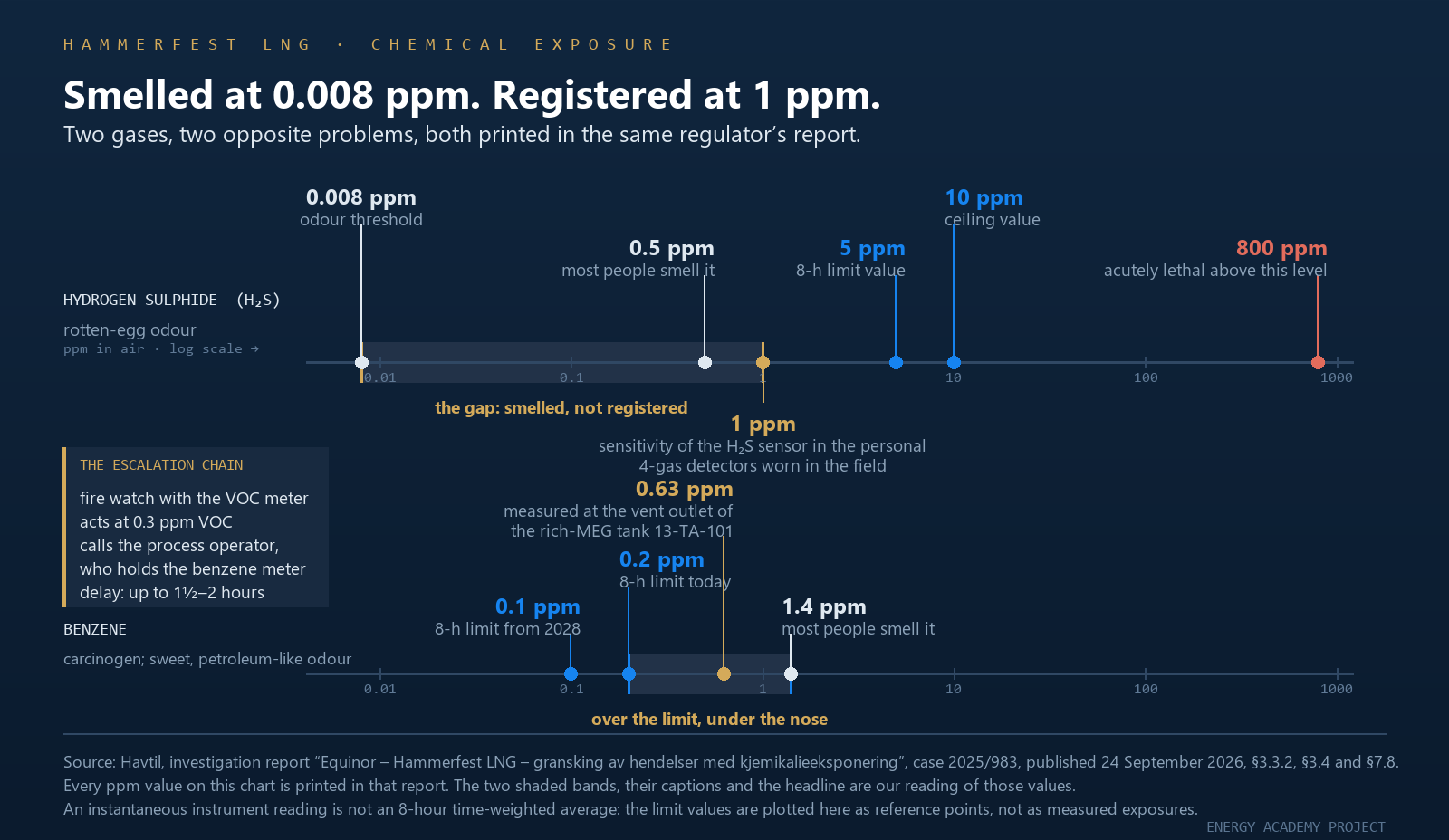
[S] §3.3.2 prints the numbers. H₂S: odour threshold "as low as 0.008 ppm", most people smell it at 0.5 ppm, 8-hour limit 5 ppm, ceiling 10 ppm. The H₂S sensors in the personal 4-gas detectors had a sensitivity of 1 ppm, which "meant that the gas could be smelled at a level that did not register on the personal monitors." Benzene runs the other way: 8-hour limit 0.2 ppm today, 0.1 ppm from 2028, while "most people can smell benzene at levels above 1.4 ppm."
[S] And §4.2 carries Havtil's own assessment, not just the numbers: "most people will detect the smell of H₂S at levels lower than the measuring instruments used at HLNG can register."
[US] Those are opposite failure modes of the same barrier. For H₂S, at the odour threshold the nose is roughly two orders of magnitude more sensitive than the instrument — and even at the 0.5 ppm level where most people notice it, still twice as sensitive — so a crew can be right and the log clean. For benzene the nose is about seven times less sensitive than the limit value, so a crew can be comfortable and wrong. A procedure that treats smell and reading as one signal will be wrong about one of the two.
The escalation chain, and its latency
[S] §3.4: benzene is the risk indicator, on the premise that control of benzene implies control of the rest. Screening is by ION CUB (photoionisation, VOC only, cheap); confirmation by Dräger X-pid (photoionisation plus separation, benzene-specific, costly, needs training) — and the Områdeansvarlige, the area-responsible personnel, "were the only ones who had the necessary competence and who held the X-pid on the plant." (§7.8 calls the same role områdeoperatør; the report uses both terms.)
[S] §7.8: after June and July 2024, fire, entry and security guards — one-day course, contractor-employed — walked L201 in pairs with CUB meters. Above 0.3 ppm VOC they withdrew and called the area operator, an Equinor process operator, who measured and decided whether to clear the area. "In every incident where the BES guards got a reading on the VOC meter and contacted the area operator to have a benzene measurement carried out, the area operator could not confirm the presence of benzene" — except on 13 June 2025. In one case the gap between reading and confirmation was as much as 1½ to 2 hours.
[US] A screening-then-confirmation chain only works if the confirmation arrives faster than the phenomenon decays. Here the latency ran to hours while the events ran to minutes — [S] §4.1 records one run of odour episodes lasting "2 to 5 minutes at a time" (other incidents ran 30 and 40 minutes). A negative measured under those conditions is not evidence of absence, and it was used to clear areas. [S] §9.4 charges exactly that: no systematic assessment was made of the instrument's limitations, of environmental influence on it, of instrument fault or of delayed response, and no occupational-hygiene expertise was involved.
The mitigation that made each release larger
[S] §7.7: venting was originally automatic — frequent, short and small, because the valve is only partly open. After June 2024 the two rich-MEG tanks went to manual venting, prepared at 60 mbar overpressure, announced over the PA, area cleared by the guards. Manual venting overrides the automatic process control and "entails larger releases per venting, since the valve will be in the fully open position" — a change in consequence potential that §9.4 records as "not documented as having been systematically assessed or compensated". Twice it failed on its own terms: on 3 December 2024 the venting appears to have been set to auto by mistake (§4.2, §7.4 — the report hedges this one), and in April 2025 tank 13-TA-101 was again "by an error set to vent automatically over a longer period" (§9.4). On 17 March 2025 personnel worked 40 minutes on top of 13-TA-102 while the neighbouring tank vented toward them; they noticed the smell in the last three minutes (§4.3). No symptoms were reported from that incident.
One caveat for anyone checking this against the report: §3.5 and §7.7 contradict each other on automatic venting. §7.7, the dedicated section, says it vents more often but with less duration and volume because the valve is largely only partly open; §3.5 says automatic venting releases over a longer period. We follow §7.7.
[US] Swapping an automatic technical barrier for a procedural one is paid for somewhere. Here it was paid in a larger release per event, into an area whose occupancy depended on an announcement reaching the right people.
What the regulator charged, and what it did not establish
[S] The four hang on Styringsforskriften §§11–12, Arbeidsmiljøloven §§4-3 and 4-4, and Forskrift om utførelse av arbeid §3-1. §9.1 carries the sharpest line. A 2021 order arising from the Johan Castberg project (Ptil 2020/1704) led Equinor to undertake that dimensioning of project manning would be a mandatory measure when engaging suppliers new to the company, and that undertaking was carried into the Snøhvit Future PDO/PIO. Equinor then took part in selecting, for a large sub-project, a contractor "with limited experience of work on petroleum facilities in operation" — and no change was made to the project organisation's manning as a result. At peak the site held about 800 people, against roughly 600 in normal operation (§3.6).
[S] On outcome: more than 30 people reported odour and/or symptoms; about 300 worked in the areas across the incidents; symptoms were mostly mild and temporary, some people were sick-listed, one for six weeks; no permanent health effects have been identified, and it has not been possible to establish with certainty which substances or levels people were exposed to. [US] Note the wording: the Norwegian §1 says flatly that no permanent health damage has been demonstrated, while Havtil's English landing page adds a qualifier the Norwegian does not — "linked solely to chemical exposure". [S] Havtil attributes much of the severity of the outcome to the working environment around the project. Identifying the source was not an objective of the investigation (§11.1). Equinor's own level-3 report, received 18 November 2025, defines 15 individual incidents over June 2024 to August 2025 — a wider window than Havtil's — and makes MEG-tank venting the probable cause of 8 of the 15; the last of them, on 2 August 2025, is expressly outside Havtil's scope. [US] We have not read that report, and pass those two figures on only as Havtil states them.
[US] And for anyone quoting this case: Havtil's three surfaces disagree on the period investigated — report body and landing-page summary say June 2024 to June 2025, the landing-page standfirst says July 2025, the news item says April 2025. Cite the caption of Tabell 1: 17.6.2024 – 13.6.2025.
What to watch next
[S] Equinor was asked to report by 29 September 2026 on how the four non-conformities will be addressed — that deadline is stated on Havtil's English landing page, not in the report itself — the first place a technical measure on the MEG tank vents would appear. Three questions for that reply: is the 2022 vent-point study re-run with the new site layout as receptor; does venting return to automatic through a modification rather than a procedural barrier; and does the specific instrument end up where the screening alarm is, instead of an hour away?
[US] And one that generalises past Melkøya: if your rich MEG comes back from a long multiphase tieback, has anyone measured what actually leaves the tank vent — or is it still assumed to be nitrogen and water vapour?