Marking convention: [S] is what the primary source states. [US] is our reading or arithmetic.
The document, and when it actually appeared
[S] Lloyd's Register EMEA wrote Integrity of Connectors in Pipelines and Subsea Systems for Havtil, the Norwegian offshore regulator: report PRJ11100465363-1, revision 0.2, dated 17 November 2025, 55 pages. Havtil published it on 24 February 2026; LR's press release followed on 20 August 2026. [US] That is when the trade press picked it up — so this is not a September document. We are writing about it now because our episode on the subsea production system went out today and stops at the hub — and we have found no other public source that puts a failure rate on the thing that sits on the hub.
[S] Havtil's brief (Appendix C) asks about components "assessed as barrier elements and which, in the event of a single point of failure, can lead to weakening of the connection", under §11 (loads) and §12 (materials) of the Facilities Regulations. One sentence of it is worth keeping: "Traditionally, welded connections are favoured. For design, installation or operational reasons, mechanical connections are used." Welded joints are then excluded from the study (§1).
How many of these things exist
[S] Nobody counts connectors, so LR estimated them (§3): every pipeline, jumper and spool in the S&P Global Offshore Fields Database (3 October 2024) was assigned two connectors; shallower than 200 m counts as diver-assisted, deeper as diverless. Declared a lower bound — it ignores every connection inside a manifold or tree envelope — the estimate is more than 18,000 diver-assisted and more than 5,000 diverless connectors in service worldwide (§3.3). The Gulf of Mexico and South America hold most of the deep-water diverless experience; in the North Sea the UK has the most connectors and Norway the most deep-water diverless ones (§3.1–3.2). [US] Two per line is a floor, but the report says twice that these figures illustrate trends, not absolute numbers: 23,000 is "at least", not a count.
The number: connectors leak less than what they join
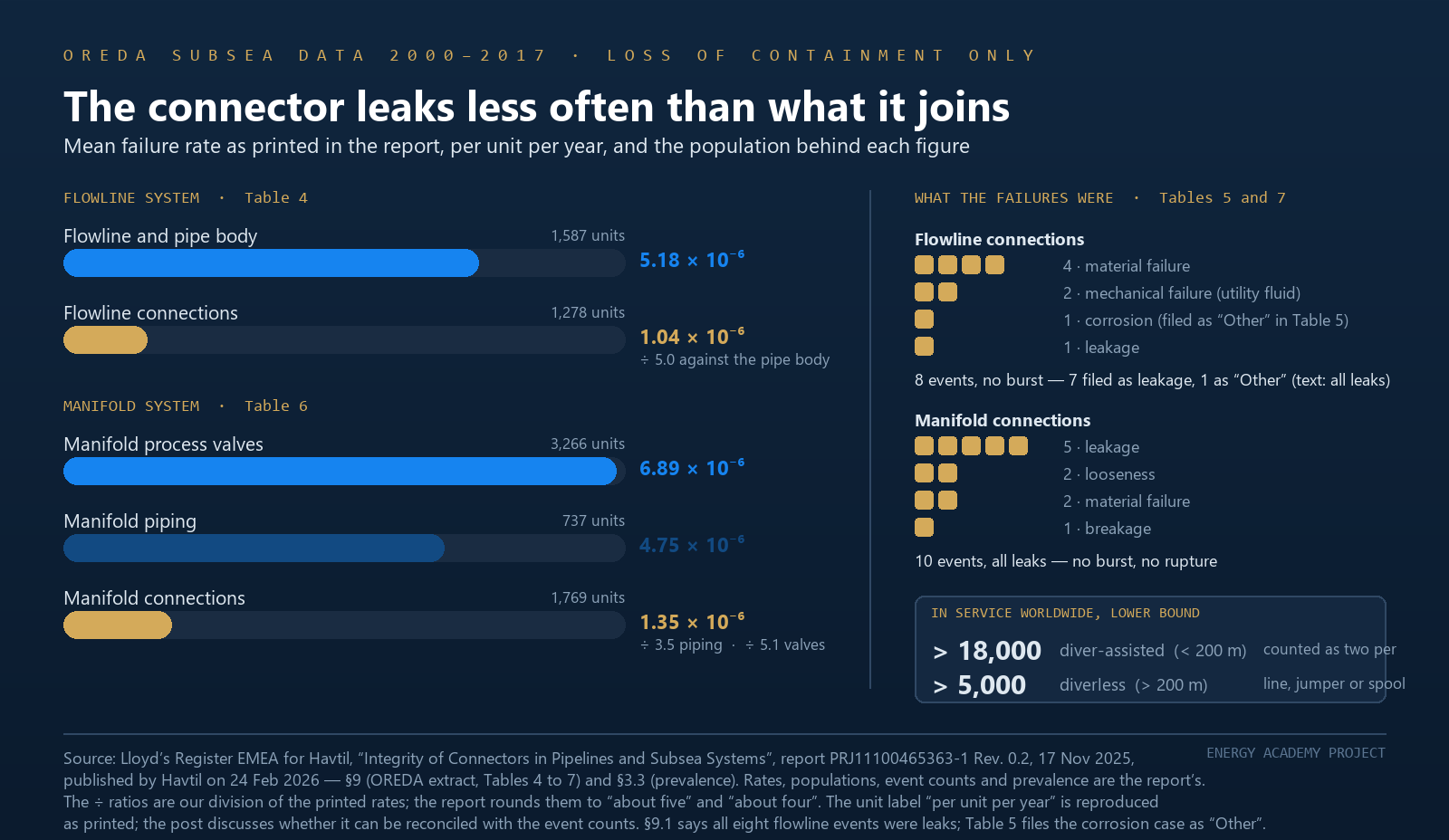
[S] §9 extracts OREDA@Cloud, Phases VI–XII, data version 3.7.4.3, subsea data 2000 to 2017, filtered to loss of containment only. Table 4: Flowline & Pipe, 1,587 units, mean failure rate 5.18 × 10⁻⁶; Connections (Flowline), 1,278 units, 1.04 × 10⁻⁶. Table 6: Manifold Piping, 737 units, 4.75 × 10⁻⁶; Manifold Process Valves, 3,266 units, 6.89 × 10⁻⁶; Connections (Manifold), 1,769 units, 1.35 × 10⁻⁶. The report calls these "approximately five times lower" than the flowline body, "approximately four times lower" than manifold piping and "approximately five times lower" than manifold valves. [US] Our division: 4.98, 3.52 and 5.10 — the "four" is a generous rounding of 3.5. And mind what a unit is here: a whole flowline against a single connection; even at two connections per line the pair comes in at 2.1 against 5.2.
[S] What the events were matters more than the rate. Flowline connections: 8 incidents in over 1,200 units — 4 material failure, 2 mechanical failure, 1 corrosion, 1 leakage (Table 5) — seven of them filed as external leakage and the corrosion case under "Other"; the text nonetheless states that all eight involved leakage. "The mechanical failures of connections were only associated with external leakage of utility fluids rather than process fluids" — hydraulic fluid, not hydrocarbons. "No catastrophic structural failures of the connections were reported as all failures involved leakages. In contrast, burst failure modes were found in flowline and pipe body data" (§9.1). Manifold connections: 10 incidents — 5 leakage, 2 looseness, 2 material failure, 1 breakage — and "regardless of the reported failure mechanism, the resulting failure mode is leakage" (§9.2). The report's explanation is mechanical, not statistical: correctly designed and installed, connections "typically possess greater thickness than the connecting pressure-containing parts and are more frequently manufactured from superior materials" (§9). Its caveat: root causes "are not known" (§9.3).
The unit label that does not survive arithmetic
[US] Tables 4 and 6 print "Mean Failure Rate /unit/year". Literally, a fleet of 1,278 connections at 1.04 × 10⁻⁶ per unit-year leaks once every 750 years; to accumulate the 8 events behind the table, OREDA would need about 7.7 million connector-years — impossible in a 2000–2017 window. OREDA's customary unit is failures per 10⁶ hours. Read that way, 8 events at 1.04 × 10⁻⁶ sit on the order of 10⁷ hours — some hundreds of connector-years, a surveillance population OREDA could plausibly hold. OREDA's mean is a multi-sample estimate, not events divided by exposure, so these are orders of magnitude, not exposures. Per year, the figures would be roughly 9 × 10⁻³ for flowline connections and 4.5 × 10⁻² for the pipe body.
We have not seen the OREDA page behind the extract, so this stays our inference — but per 10⁶ hours is the only reading that is physically possible. What does not depend on it is the ratio: connection and pipe are in the same unit, whichever it is, and five-to-one holds either way. Lifting "10⁻⁶ per year" into a QRA unchecked would be wrong by a factor of nearly ten thousand.
What the rate cannot tell you
[S] The data stops in 2017 and does not separate flanged, clamp-hub, collet and proprietary systems; §12 concedes that "detailed failure data for different connector types is not readily available in the public domain." What the report offers instead is qualitative. Collet connectors are "widely used for jumper spool connections and wellhead connectors" (§5, opening list — four families, five counting gripping adapters). Some proprietary diverless clamp connectors "may rely upon a single locking screw to maintain the clamping force on the hubs", and "these single point of failure elements may not be readily inspectable during the service life" (§7). An ILI tool runs through a connector and reads nothing of it: "it is not possible to inspect connectors in such detail due to high thickness of components and the inherent variation and complexity of geometries of proprietary connectors", so inspection is visual plus cathodic protection, concentrated on "non-redundant parts which may become a single point failure source, such as locking screws" (§11.3).
[US] That is the engineering shape of the finding: the connector is the thick, alloy, over-designed part of the system, and the part you can least inspect. Its integrity is bought in design, qualification and make-up. The report's framing (§10) is API RP 17N's technical risk categorisation, scored A to D per component and lifecycle stage, with API RP 17Q setting the qualification effort; the connector standards it leans on are API Spec 17D, ISO 13628-7 (which ISO has since withdrawn; the API equivalent is RP 17G), API 17TR7 and API RP 17R (Appendix B).
Where this touches the episode
[US] Today's episode ends the jumper at "the two hubs it connects" and gives it API RP 17R. What this report adds is what the episode could not say for lack of a source: on the only public extract of a connection failure rate we have found, the connection is not the weak link — the pipe body and the valves are — and every recorded failure was a leak, never a rupture. A jumper bent to absorb hub movement and locked with a connector nobody can later inspect is exactly the item where the qualification file is the integrity file.
What to watch
- Whether Havtil turns this into supervision under §§11–12 of the Facilities Regulations; the report asks operators to keep design and qualification records for life extension (§11.4, NORSOK U-009, ISO 12747).
- OREDA's post-2017 subsea phases — nearly a decade of newer connector designs is absent here.
- A per-type split. If an operator or JIP publishes collet against clamp against proprietary, five-to-one becomes a design choice rather than a comfort.