Marking convention: [S] is what the primary source states. [US] is our reading or arithmetic.
The result, and the detail that was not in the headlines
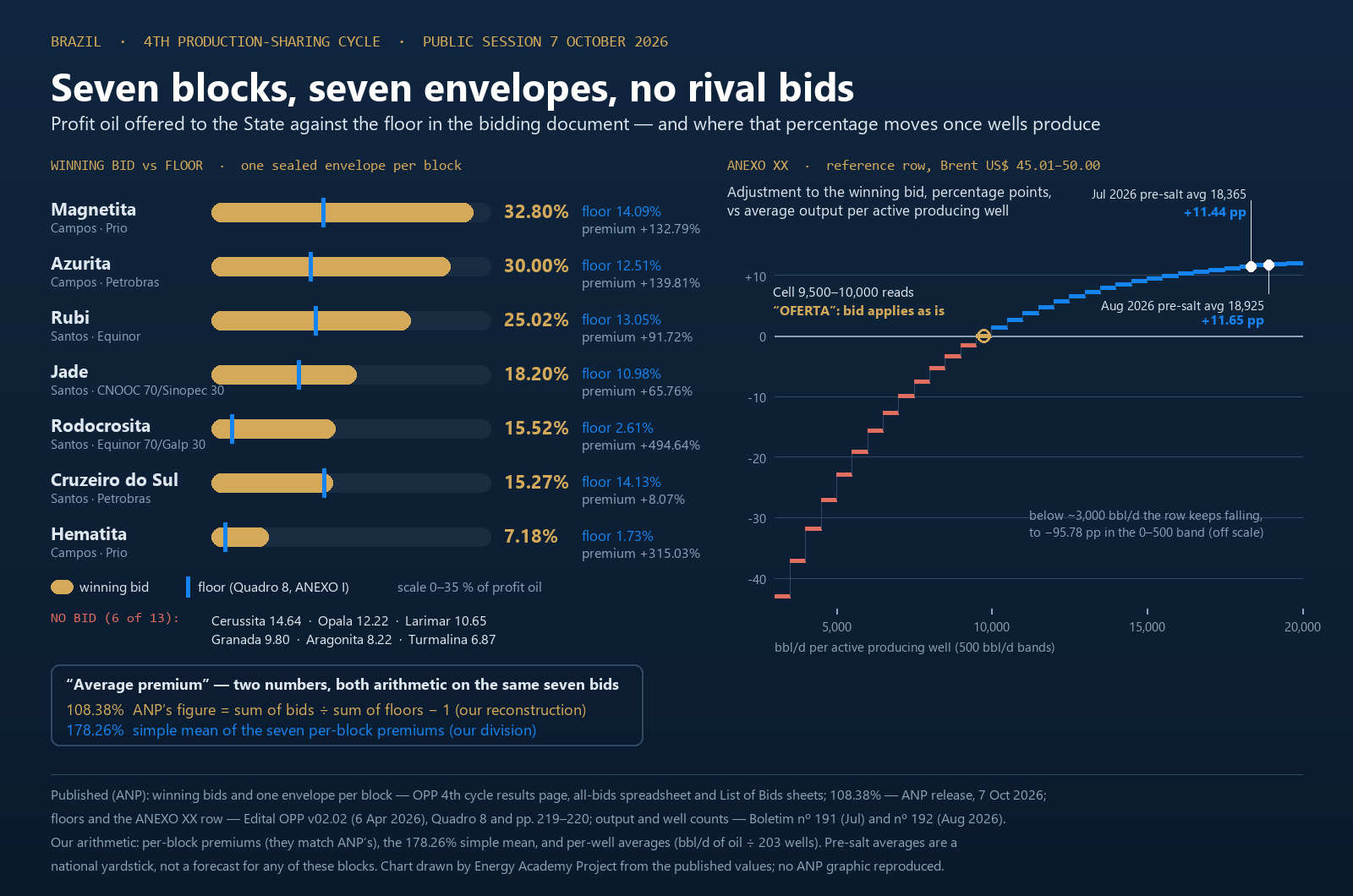
[S] At the public session of the 4th cycle of the Oferta Permanente de Partilha on 7 October 2026, the ANP awarded seven of the thirteen production-sharing blocks on offer: Magnetita, Hematita and Azurita in Campos; Jade, Cruzeiro do Sul, Rubi and Rodocrosita in Santos. Signing bonuses — fixed in the bidding document, not bid — came to R$ 530,466,522.04, and committed exploration-phase investment to R$ 778,426,200.00. Both figures equal the sum of the seven rows in Quadro 8 of the edital, which we checked.
[S] The regulator's results page carries a bid sheet for each block. Every sheet lists one envelope. Six companies bid; all six won. Cerussita, Opala, Larimar, Granada, Aragonita and Turmalina got no bid at all.
[US] So the premium of 494.64% on Rodocrosita — the number in most headlines — was not won against anyone. Equinor (70%) and Galp (30%) wrote 15.52% against a floor of 2.61%, alone. A sealed single bid tells you what one company thinks the block is worth. It tells you nothing about what a competitor thought, because there wasn't one.
Two ways to average the same seven premiums
[S] The ANP's release gives an average premium of 108.38%. It does not say how that average is taken.
[US] There is more than one defensible way to average seven premiums, and here they give very different answers. Take the seven winning bids and the seven floors. Sum of bids over sum of floors, minus one: 108.38% — the ANP's number to the second decimal, so that is almost certainly how it is calculated, although the release does not say so. The simple mean of the seven per-block premiums is 178.26%. The gap comes from two low-floor blocks: Rodocrosita and Hematita, with floors of 2.61% and 1.73%, produce premiums of 495% and 315% on modest absolute bids, and they dominate a simple mean. Without them, the other five average 88%.
The lesson is older than this auction: a percentage of a percentage needs its formula stated. Our own pre-auction post quoted the 3rd cycle's "average premium of 91.20%" without one. We still don't know which average that is.
The correction: the annex has a neutral cell
[S] Item 7.5 of the edital says the bid must refer to Brent at US$ 50.00 and 10,000 bbl/d of oil per active producing well. ANEXO XX turns that into a grid, Brent bands down the side and productivity bands of 500 bbl/d across the top. In the row US$ 45.01–50.00, the cell 9,500–10,000 bbl/d does not hold a number. It holds the word "OFERTA" — the bid applies as written — and every other cell is a signed adjustment in percentage points.
[US] On 19 September we wrote that there was no neutral cell and that this one carried a small negative adjustment. That was wrong: on the rendered page the reference cell is highlighted and labelled, and we misread it. The neighbours are −1.57 pp (9,000–9,500) and +1.41 pp (10,000–10,500). The magnitudes we gave further out were right: in the same row the adjustment reaches +11.44 pp at 18,000–18,500 bbl/d and +11.65 pp at 18,500–19,000. At the bottom end it falls to −95.78 pp in the 0–500 band, and the low-price rows bottom out at a flat 1%. The 19 September post now carries a dated correction pointing here.
Why an engineer should care: well count is a fiscal variable
[S] In August 2026 the pre-salt produced 3,841,869.23 bbl/d of oil from 203 wells (ANP bulletin nº 192). [US] That works out to 18,925 bbl/d per well, up from 18,365 in July — both in the +11 pp region of the reference row.
[US] That is a national average across mature giants, not a forecast for any of these blocks — several of which may never produce. What it shows is the shape of the contract. The State's share does not depend on total field output. It depends on output per active producing well, averaged monthly (item 7.5) at the monthly Brent Dated average (7.6). Gas is shared at the same percentage (7.7).
That puts a fiscal number inside a technical decision. Two development concepts that deliver the same plateau — say, more wells at lower rate against fewer, longer-reach or higher-capacity wells — land in different columns of ANEXO XX. The well count, the completion design and the slot count on the manifold are no longer only reservoir and subsea choices; they move the profit-oil split. Under item 7.8, wells restricted for technical or operational reasons and booked as losses can be left out of the average, at PPSA's discretion. That discretion will matter the first time a field runs wells choked back for sand, water or flow-assurance limits.
If you work on the subsea production system — trees, manifolds and the wells they collect, the subject of our SPS episode — this is where the architecture shows up in the contract.
What the numbers do not say
The edital gives no water depth for any block, and neither do the results. Any depth you see attached to these names this week came from somewhere else. The results don't explain why six blocks drew no bid either. Cerussita had the highest floor of the thirteen (14.64%) and the largest fixed bonus (R$ 329.1 million); Opala had the second-largest bonus (R$ 249.1 million). Together the six unsold blocks carried R$ 704.5 million of bonus, more than the seven that sold. That is an observation from one cycle, not a cause.
What to watch
- Winners' qualification documents due 14 October, adjudication by 18 November, per the published schedule. A single-bid block whose winner fails qualification has no runner-up.
- Contract signature by 26 February 2027. We still have not confirmed that the 3rd cycle's contracts, due by May 2026, were signed.
- Whether the six unsold blocks return in a later cycle, and at what floor.
- The first development plan out of this cycle. When one of these blocks reaches a concept select, the productivity axis of ANEXO XX will be sitting in the well-count trade-off, whether or not the field-development team has been told.