Correction, 12 October 2026: this post originally said that ANEXO XX of the bidding document has no neutral cell and that the cell at Brent US$ 45.01–50.00 and 9,500–10,000 bbl/d carries a small negative adjustment. That was wrong. On pp. 219–220 of the edital that cell reads "OFERTA": the winning bid applies as written. The small negative adjustment belongs to the neighbouring 9,000–9,500 bbl/d band (−1.57 pp). The roughly +11 pp at pre-salt productivity, and the rest of the argument, stand. The two corrected sentences are marked below; the auction result and the full correction are in Seven Blocks, Seven Envelopes.
What happens on 7 October
Brazil holds the public bidding session of the 4th cycle of the Oferta Permanente de Partilha de Produção — the production-sharing permanent offer — on 7 October 2026. Thirteen exploratory blocks are on the table: five in the Campos basin (Magnetita, Turmalina, Hematita, Larimar, Azurita) and eight in Santos (Jade, Aragonita, Cruzeiro do Sul, Opala, Granada, Cerussita, Rubi, Rodocrosita).
Adding up the per-block figures in the regulator's own bidding document gives 25,717.531 km² of acreage, R$ 1,235,012,266.54 in signing bonuses and R$ 1,414,648,800.00 of committed minimum investment. Those three totals are our addition of the thirteen rows; every row is the ANP's.
A separate concession cycle — the 6th OPC, with 24 areas across nine basins — runs alongside it. The two are different regimes and get confused constantly. Concession and production sharing are not variants of one auction.
One variable
In a concession round you can win on signature bonus, on work programme, on local content. Here you cannot. The signing bonus is fixed per block, printed in the annex. The minimum exploratory programme is fixed, expressed in work units — 266 UT for most of these blocks, over a seven-year exploration phase. Local content is fixed.
The only number a bidder writes down is the percentage of profit oil offered to the State, to two decimal places. Highest percentage wins.
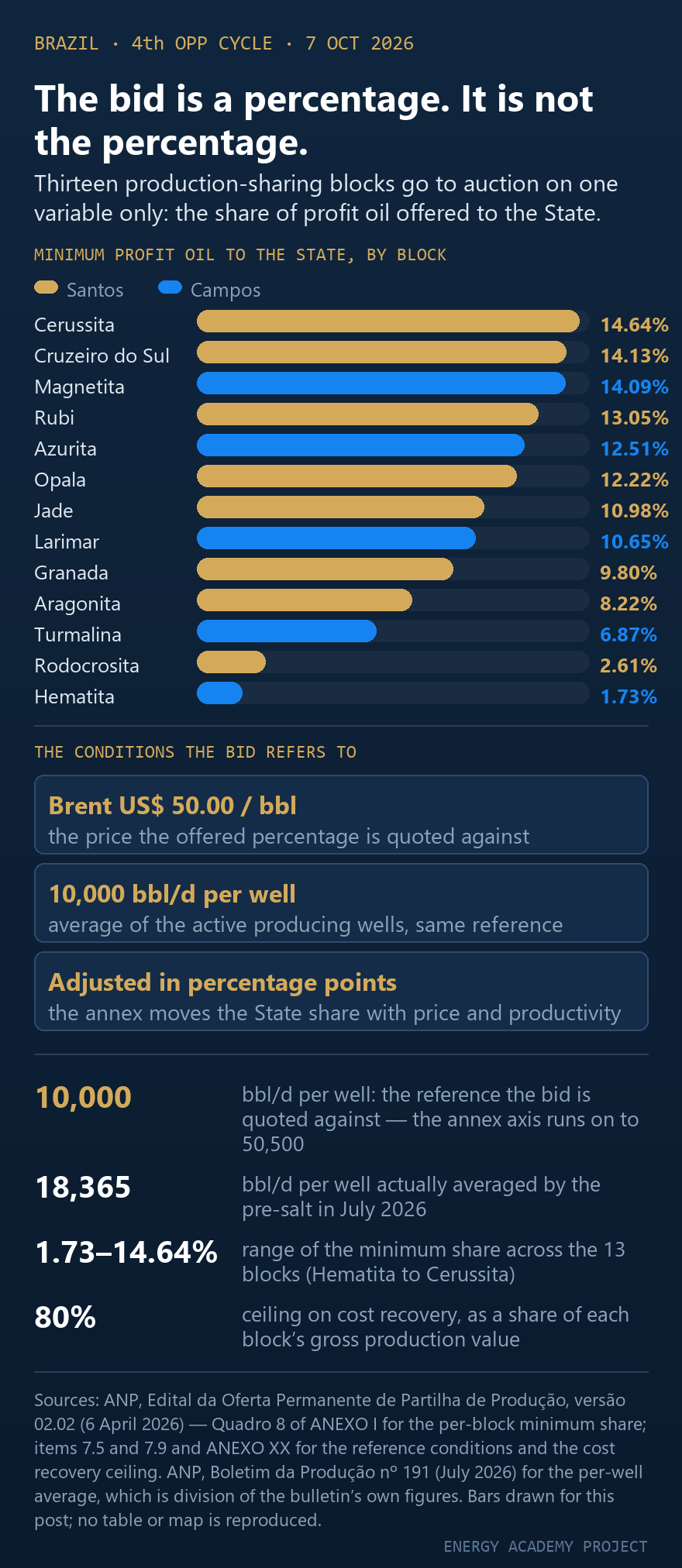
Each block carries a floor. Across the thirteen, that floor runs from 1.73% (Hematita) to 14.64% (Cerussita) — a factor of about 8.5 between blocks in the same auction, in two adjacent basins. The floor is not a judgement about generosity; it is the regulator pricing geological risk block by block before anyone bids.
The part that does not travel
Here is the clause that decides what those percentages mean, and it is almost never quoted. Item 7.5 of the bidding document states that the percentage offered by bidders must refer to a Brent price of US$ 50.00 per barrel and to an average daily production of 10,000 barrels of oil per active producing well.
The winning percentage is therefore not a share. It is a coordinate. ANEXO XX of the same document is a grid: rows are Brent price bands, from the lowest up to above US$ 200.01; columns are bands of average production per active producing well. Each cell carries an adjustment in percentage points to be applied to the percentage that won the auction. One cell is neutral: at Brent US$ 45.01–50.00 and 9,500–10,000 bbl/d the annex prints the word "OFERTA" — the bid applies as written. Its neighbours already move it: −1.57 pp at 9,000–9,500 bbl/d, +1.41 pp at 10,000–10,500 bbl/d, and +1.02 pp in the same productivity band one price row up, at Brent US$ 50.01–55.00. Wherever else the field actually lands, the State's share moves. [Corrected 12 October 2026. This passage previously read: "There is no neutral cell. […] the cell at Brent US$ 45.01–50.00 and 9,500–10,000 bbl/d already carries a small negative adjustment, and the band above the reference price carries a small positive one."]
Two features of that grid matter to anyone reading auction results.
The adjustments are large. They are quoted in percentage points to four decimals, and in the low-productivity bands they run to tens of points negative — enough to drive the State's share to the 1% floor the table applies in its top-left corner. A bid of 14% into a field that underperforms is not 14%.
The productivity axis does not stop at 10,000 bbl/d per well. It carries on, in 500 bbl/d bands, across five consecutive pages of the annex, to a last column of 50,000–50,500 bbl/d. And in July 2026 the Brazilian pre-salt produced 3,728,074 bbl/d from 203 producing wells — an average of 18,365 bbl/d per well, which is division of two figures published in the same ANP bulletin. That average lands well inside the table, not off the end of it.
Read along the reference price row — Brent US$ 45.01–50.00 — the adjustment is zero in the 9,500–10,000 bbl/d reference cell and negative below it, and by the bands around 18,000 bbl/d it has risen to roughly +11 percentage points. So productivity does not leave the State's share where the bid put it: at pre-salt performance it lifts it substantially. The winning percentage is neither a floor nor a ceiling — it is the reference the table moves from, downward when the field disappoints and upward when it does not.
We read the annex directly in the bidding document's PDF. We quote the magnitude and not the four-decimal cell values, because aligning a row and a column by hand across a five-page table is exactly the kind of reading that can be off by one of each. [Corrected 12 October 2026: the sentence before this note previously said "the adjustment near the 10,000 bbl/d reference is negative".]
That two-way movement is the design. The mechanism protects the bidder against a disappointing reservoir, and hands the State the upside on both axes — when crude is expensive and when the reservoir is exceptional.
Three more numbers with engineering consequences
Cost recovery is capped at 80%. Item 7.9: each month the contractor takes the cost oil parcel up to 80% of the gross production value of each block, with the excess carried forward to later years. That is a materially higher ceiling than the one documented for Libra, the first sharing contract, where the contract manager PPSA has described a limit of 50% of monthly production value, falling to 30% once past costs are recovered. We have not re-verified the Libra figures against PPSA this week; the 80% is the current edital's, read directly. If you carry "50/30" in your head as the pre-salt cost recovery rule, it is not the rule being auctioned in October.
Local content is highest on the subsea scope. Quadro 10 sets the minimums identically for every block: 30% in the exploration phase, and in the development stage 30% for well construction, 40% for the gathering and flow system, and 25% for the stationary production unit. The gathering and flow system — flowlines, risers, umbilicals, the manifolds and jumpers that connect them — carries the highest minimum of the three development macro-groups. The hull can be built abroad more freely than the SURF scope can.
Petrobras took no preference. Quadro 9 lists the statement of the operator preference right for all blocks in the permanent offer inventory, and the answer is "Não" for every one, with 100% of each block offered to the market. Since 2016 the company has a right of first refusal on sharing blocks, not an obligation to operate; on this inventory it declined across the board.
What is not in the document
The block table gives area in km². It does not give water depth. Bathymetry sits in the paid technical data package and in the general map, not in the parameters annex — so any water-depth figure you see attached to these blocks in coverage this month did not come from the bidding document.
And a small warning for anyone reading the edital themselves: items 7.4 and 7.20 both point to column (xiii) of Quadro 8 for the minimum percentage, while in the table's own header (xiii) is the exploration phase in years and (xiv) is the minimum profit oil. Read the column heading, not the cross-reference.
What to watch
- The spread of the premiums on 7 October. The 3rd cycle, in October 2025, closed with an average premium of 91.20% over the minimum percentages. If that repeats against floors as low as 1.73%, the headline percentages will look small and mean more than they look.
- Whether the low-floor blocks attract a bid at all. Hematita at 1.73% and Rodocrosita at 2.61% are priced as frontier risk. Empty blocks are as informative as contested ones.
- Signature by 26 February 2027, with the signing bonus due by 30 December 2026. The 3rd cycle's contracts had a May 2026 deadline; confirming that those were actually signed is still an open item for us.
- Whether anyone quotes the reference conditions. When the results are reported as "X% to the State", the number will be a coordinate at US$ 50 Brent and 10,000 bbl/d per well. It will be reported as a share. It is not one.